NACTAL to lawmakers: Scrapping NAPTIP will embolden traffickers
NACTAL to lawmakers: Scrapping NAPTIP will embolden traffickers
By Prosper Okoye
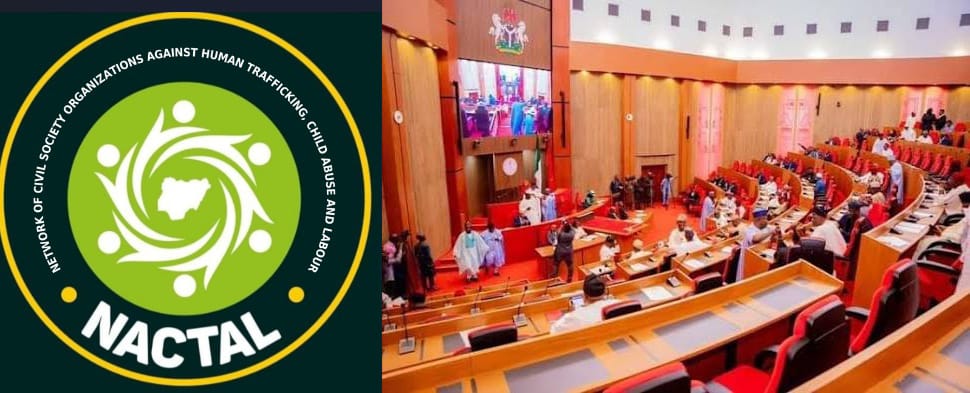
The Network of Civil Society Organisations Against Human Trafficking, Child Abuse and Labour (NACTAL) has warned the National Assembly against scrapping or merging the National Agency for the Prohibition of Trafficking in Persons (NAPTIP), saying such a move could embolden human traffickers and undermine Nigeria’s fight against organised crime.
The network called on President Bola Tinubu, the leadership of the National Assembly and international development partners to intervene over what it described as attempts to dismantle or weaken the country’s specialised anti-trafficking institution.
In a statement issued on Friday, November 20, and signed by its National President, Comrade Osita Osemene, NACTAL expressed concern over the reported activities of the House of Representatives Special Committee on Restructuring of Federal Agencies, which it said had subjected NAPTIP to repeated documentation requests and institutional scrutiny since late 2024.
The network alleged that the committee had repeatedly requested documents reportedly submitted previously, amid threats or indications that the agency could be scrapped or merged.
While acknowledging the constitutional oversight responsibilities of the National Assembly and the need to improve public sector efficiency, NACTAL cautioned that restructuring should not become a justification for dismantling institutions established to protect lives, defend human rights and combat organised crime.
It argued that human trafficking, which involves sexual exploitation, forced labour, child trafficking, domestic servitude, illegal adoption, forced criminality and trafficking for organ removal, requires specialised investigative expertise, intelligence capabilities and dedicated prosecution structures.
According to the organisation, merging NAPTIP with an agency whose mandate is different or broader could disrupt ongoing investigations, compromise victim protection and create operational gaps that criminal networks could exploit.
NACTAL said NAPTIP’s record demonstrated why the agency should be strengthened rather than dismantled.
It cited 190 human trafficking convictions secured between January 2022 and August 2024, alongside 20 convictions for rape and incest during the same period.
The network also listed the agency’s expansion to 33 states, the establishment of anti-trafficking and violence-prevention vanguards in 154 secondary schools, and the strengthening of cybercrime investigations to tackle technology-facilitated trafficking and online exploitation among its achievements.
It further highlighted NAPTIP’s rescue and support services for trafficking survivors, including shelter, medical, psychosocial and legal assistance, as well as rehabilitation and reintegration programmes.
The organisation also pointed to what it described as Nigeria’s landmark reported prosecution involving human trafficking for organ harvesting, saying it demonstrated the agency’s capacity to confront emerging forms of organised crime.
Figures publicly reported by NAPTIP in November 2026, according to NACTAL, showed that the agency had rescued and supported 28,762 victims and secured 857 convictions since its establishment.
Beyond its domestic operations, NACTAL said NAPTIP had become an important reference point for other African countries, including The Gambia, Niger and Ghana, which had drawn lessons from Nigeria’s institutional framework and operational experience in combating human trafficking.
It warned that dismantling the agency would not only undermine Nigeria’s domestic anti-trafficking response but also represent a setback to its regional and international leadership in the fight against the crime.
On the implications of the proposed restructuring, NACTAL said it had no evidence linking any lawmaker or individual behind the proposal to human trafficking and would not make such an allegation.
However, it maintained that any action that compromised NAPTIP’s operational capacity would inevitably serve the interests of traffickers, child exploiters and organised criminal networks that thrive where enforcement is weak.
The organisation therefore asked the House committee to provide a transparent justification for any proposal to scrap or merge the agency, including an assessment of the consequences for national security, ongoing investigations, prosecutions, victim protection and Nigeria’s international obligations.
NACTAL also warned that weakening NAPTIP could affect the wider network of civil society organisations and community-based interventions that support the agency’s work.
It said its partnership with NAPTIP involved community mobilisation, public awareness, victim identification and referrals, survivor support, rehabilitation, reintegration, policy advocacy and capacity development.
Through its member organisations and state chapters, the network said it connected national anti-trafficking interventions with vulnerable communities and strengthened the referral systems on which survivors depended.
The organisation called on Tinubu to ensure that NAPTIP was neither scrapped nor merged in a way that compromised its statutory mandate and operational effectiveness.
It urged the Senate President and Speaker of the House of Representatives to ensure that legislative oversight included consultations with civil society organisations, survivor representatives and other relevant stakeholders.
The House committee was also asked to reconsider any proposal to scrap or merge NAPTIP and consolidate its documentation requests instead of repeatedly demanding previously submitted records.
NACTAL further appealed to the European Union, the United States Department of State’s Office to Monitor and Combat Trafficking in Persons, the International Organisation for Migration, the United Nations Office on Drugs and Crime, UNICEF, UN Women and ECOWAS to engage Nigerian authorities on preserving the country’s anti-trafficking framework.
It said international intervention was particularly important for migration governance, anti-trafficking programmes, survivor protection and reintegration investments.
However, the network acknowledged that NAPTIP, like other public institutions, required improvements in funding, accountability, staffing, technology, operational efficiency and inter-agency coordination.
Rather than scrapping the agency, it advocated increased budgetary support, expansion of its operational presence to all 36 states and the Federal Capital Territory, stronger investigative and prosecutorial capacity, improved survivor-centred services and sustained partnerships with civil society organisations.
“NAPTIP must not be scrapped. NAPTIP must not be merged into irrelevance. NAPTIP must be strengthened,” Osemene said in the statement.
NACTAL warned that Nigeria could not afford to reverse decades of progress in combating human trafficking, insisting that the protection of vulnerable women, children and men depended on maintaining an effective national response.
About Post Author